
Why the Laundry Room Deserves Better
Laundry is a fact of life – but your laundry room doesn’t have to feel like a dingy afterthought. In many homes, the laundry area has long been treated as a utilitarian corner or a basement nook. Today’s homeowners are starting to expect laundry room specifications and designs on par with kitchens and baths. In this guide, we’ll explore how smart planning and modern laundry room design can transform this space from a mere “utility” into a daily convenience.
A well-designed laundry room is more than a place to wash clothes – it can improve your daily routine, protect your home, and even boost resale appeal. Homebuyers consistently rank a separate laundry room among their most-wanted features. In fact, a recent NAHB survey found that laundry rooms are desired by 86% of buyers, making them one of the top “must-haves” in a home. This shows that investing in good laundry room specifications and layout isn’t just about chores, it’s about adding value and comfort to your home.
Modern families also demand more from their laundry areas than ever before. It’s not uncommon for the laundry “room” to double as a mudroom, pet care station, or hobby space. With the right laundry room design specifications, even a small room can work overtime. By reimagining this space with the same care given to a kitchen remodel, you can streamline daily tasks and make laundry less of a bore and more of a breeze.
At MGS Contracting Services, we believe any hardworking space should get the VIP treatment. “We design laundry rooms the same way we design kitchens — for workflow, durability, and real life,” says the MGS design team. In this comprehensive guide, we’ll walk through the building and design specifications for a laundry room that is functional today and “future-ready” for tomorrow’s needs. From optimal appliance spacing and ergonomic layouts to storage, safety, and style – consider this your blueprint to a laundry room that works as hard as you do.
(Throughout this blog, we’ll sprinkle the phrase “laundry room specifications” frequently – not just for emphasis, but to help those searching for guidance on designing the perfect laundry space!)
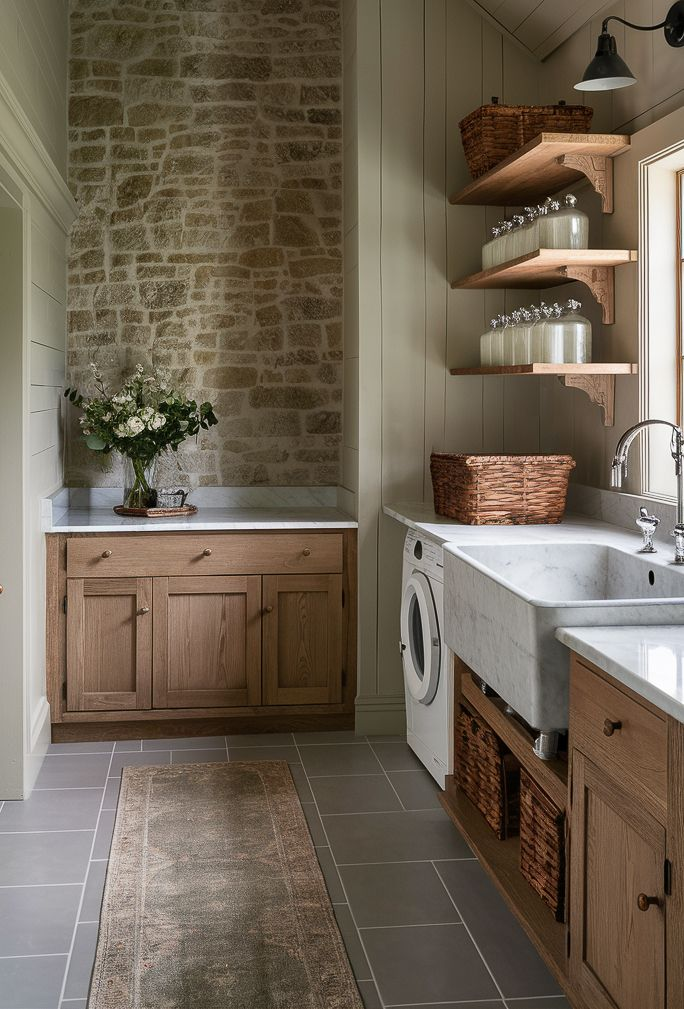
CREDIT: PINTEREST
What Today’s Homeowners Really Want in a Laundry Room
Before diving into the nuts and bolts of laundry room specifications, it helps to understand the latest trends and homeowner preferences. Our team at MGS has seen firsthand what families ask for in their laundry renovations, and national data echoes these requests.
The Rise of the Dedicated Laundry Room
Once upon a time, the “laundry room” might have been an exposed washer-dryer in the basement or a corner of the garage. Not anymore. Today, a separate, dedicated laundry room is considered standard in new homes. 95% of new homeowners request a separate laundry room, according to a 2019 NAHB survey. In other words, having a well-equipped laundry area is almost as expected as having a kitchen! Modern buyers aren’t looking for a washer in a closet; they want a defined space for cleaning clothes.
Location is another key consideration. An NAHB report notes that 61% of new laundry rooms are being built on upper levels (near bedrooms) rather than on the first floor or basement. Why the shift upstairs? Convenience. Most of the laundry we generate (clothes, bedding, towels) lives near the bedrooms, so hauling baskets up and down stairs is a pain best avoided. A second-floor laundry means fewer trips and easier access – especially helpful for busy parents or anyone with mobility issues. No wonder many designers now say “the laundry room should follow the primary suite”, locating it by the master bedroom if possible.
That said, there are pros and cons to each location. First-floor laundry rooms (often by the kitchen or garage entry) are great for multi-tasking – you can toss in a load while cooking dinner – and keep noise away from sleeping areas. They often double as mudrooms (more on that below). Basement laundry rooms offer the advantage of isolating noise and potential leaks to a less-critical area, but they’re the least convenient for daily use (all those stairs!).
Upper-level laundry rooms win on convenience, as mentioned, but come with special considerations: you’ll want to be sure to address noise, vibration, and leak prevention since they sit among living and sleeping spaces. We’ll cover those laundry room specifications for soundproofing and safety later in this guide.
Bottom line: homeowners today overwhelmingly want a dedicated laundry room, and many prefer it on the main or bedroom level for convenience. If you’re designing a new home or considering moving your laundry, think about your household’s workflow. MGS Contracting Services can help weigh the laundry room specifications for each location – from adding floor drains upstairs to reinforcing floors for vibration – so you get convenience without unwanted trade-offs.
Multi-Functional Is the New Normal
Another big trend is making the laundry room a multi-tasking superstar. In many of our MGS remodeling projects, the laundry area isn’t just for laundry anymore. It might share space with a mudroom, a pet washing station, a craft or sewing corner, or more. Homeowners are looking to combine functions to maximize every square foot.
One popular combo is the laundry room + mudroom. This pairing makes sense: both are “workhorse” spaces, and together they create a central hub for managing the mess of daily life. A mudroom entry with hooks, cubbies, and benches for shoes can flow right into the laundry area. That way dirty sports uniforms or wet snow pants go straight into the washer instead of traipsing through the house. As Better Homes & Gardens notes, “combining a laundry room with a mudroom maximizes space”, especially when you incorporate practical storage like hooks, cubbies, and low-profile organizers. A shared laundry-mudroom can be the most hardworking room in the home, catching mud, pet paw prints, and grass stains all in one spot.
Speaking of pets: more homeowners now ask us to incorporate pet care stations into their laundry room specifications. This can be as simple as a sprayer attachment on a deep laundry sink for washing the dog, or as elaborate as a built-in dog-washing shower. Since cleanup tasks already happen here, why not make it pet-friendly? Some designs include a low tiled dog wash basin or an open shower stall in the laundry area, complete with a handheld shower head. Even a cozy pet bed nook can be built under a folding counter. We’ve seen clients add pull-out trash bins for pet food or built-in crates in the cabinetry.
Laundry room specifications can easily include our furry friends’ needs. One trendsetting laundry room in Denver, for example, features a stacked washer-dryer (to save space for cabinets and a sink) plus a bonus: a tiled niche for pet bowls with its own water faucet – keeping Fido hydrated and happy in style.
An efficient multi-purpose laundry room with stacked washer-dryer, a utility sink, and even a built-in pet bowl station (bottom left). Smart laundry room specifications like these allow a single space to handle washing clothes, pet care, and mudroom duties all at once.
Laundry spaces are also doubling as hobby or task areas. We’ve designed laundry rooms that include a sewing table or craft station, with the logic that you already have a big flat surface and storage cabinets – why not use them for wrapping gifts or scrapbooking? Some laundry rooms house cleaning supply closets, recycling bins, or gardening tool storage. A bright, pleasant laundry room can even serve as an extra small office or homework area in a pinch (just keep the noise of the dryer in mind!). The key is thoughtful layout so that these uses don’t conflict. For instance, if you want a craft corner, allocate counter space and storage for it, and perhaps include a stool so someone can sit and work while a load is running.
The rise of multi-functional laundry rooms ties directly into homeowners’ high expectations. A generation ago, nobody expected to like their laundry area. Now, clients tell us they want it to be “a pleasure to be in” and to accommodate various tasks. As one Houzz article put it, people are looking for laundry rooms that have it all – washing, drying, hanging, folding, soaking areas – plus style. That’s a tall order for often small spaces! It requires savvy design and careful laundry room specifications to fit everything in comfortably. But it’s doable, and incredibly rewarding when done right.
“Small Room, Big Expectations” – Why Planning Matters More Than Size
Here’s a little secret from our renovation team: a small laundry room that’s well-designed can trump a large one that’s poorly planned. Many homeowners come to us with laundry spaces that are plenty big, yet still dysfunctional – no storage, cramped appliance clearance, poor lighting, you name it. Meanwhile, we’ve turned tiny closet-like laundries into marvels of efficiency with the right laundry room specifications. The lesson? Intentional planning matters more than square footage.
In fact, smaller laundry rooms demand even more careful planning. When every inch counts, you need to map out where the hamper goes, where detergents will be stored, how the doors will open, etc. Overlooking these details leads to common regrets. Some common laundry room design mistakes we hear about include: not enough counter space for folding, no rod or rack for hanging drip-dry clothes, upper cabinets so high you can’t reach them, or pathways blocked by open appliance doors. Homeowners who rush a laundry remodel without thinking it through often say “I wish I had put in more shelves” or “we should have added a built-in ironing board” once they start using the space. Laundry room specifications should anticipate the daily workflow.
One huge regret is designing too tight a space around the washer and dryer. It might look neat in a floor plan, but if you can’t comfortably load and unload laundry, you’ll be cursing that beautiful built-in cabinet that is 2 inches too close to the dryer door. Remember that humans need to move with the laundry – carrying baskets, reaching for hangers, etc. We always ensure there is adequate circulation space (more on specific clearance recommendations soon) so that doing laundry isn’t like solving a puzzle in a closet.
Another pitfall is prioritizing looks over function. Of course we all want an attractive laundry room with trendy tile or cabinetry – and you can have that. But never at the expense of workflow. For example, glass-front cabinets look gorgeous, but if they don’t fit your Costco-sized detergent bottles, you’ll end up storing them on the floor. A chic marble countertop won’t make you happy if it’s too high or too small to fold sheets on. We’ve had clients come to us after DIY-ing a Pinterest-pretty laundry room, only to redo it with MGS because it wasn’t practical. Our approach is to blend form and function: choose materials that are beautiful and durable, and plan the layout for real-life use. That’s how you avoid those “design mistakes” that pros talk about, like poor lighting, insufficient storage, and improper ventilation – issues that can turn your shiny new laundry room into a headache.
In short, today’s homeowners expect a lot from laundry rooms. Even if the space is small, they want it to work hard and look good. The good news is that with the right laundry room specifications and a bit of creative design, you can meet and even exceed those expectations. Next, we’ll dive into the nuts and bolts of appliance planning – truly the foundation of any laundry room design.
Designing for Appliances — Now and in the Future
Laundry rooms revolve around appliances. The size, type, and placement of your washer and dryer (and maybe a pedestal or a stacked pair) will largely dictate your layout. That’s why a huge part of laundry room specifications is planning around these big metal boxes. But here’s a key tip: design for the future, not just the present. Appliances change over time – yours might die in 5 years, or you might upgrade to a larger capacity, or a future buyer might have different machines. We want your laundry room to accommodate those changes with minimal fuss.
Don’t Design Around Today’s Washer & Dryer
It’s tempting to create a custom cabinetry nook that perfectly frames your current washer and dryer – down to the last quarter inch. Don’t do it! Today’s models might be a completely different size than tomorrow’s. Appliance technology evolves quickly (who knows, you might get one of those new deep-capacity washers or a heat-pump dryer in a few years), and manufacturers don’t keep dimensions standard forever. If you over-customize the space to your exact units, you (or the next homeowner) could be in a bind when it’s time to replace them.
As laundry expert Mary Marlowe Leverette advises, “No matter how much you love your current washer and dryer, you will replace them someday. Don’t customize the laundry room design to the appliance units you have now. Instead, leave extra space beside and above appliances.” This means when framing out cabinetry or counters around your machines, build in some wiggle room. An inch or two of buffer on each side and a bit of headroom overhead can save you from an expensive retrofit later. The Spruce also notes that while built-in cabinets around appliances look great, if you move, the next buyer’s machines might not fit that space. Universal sizing is part of smart laundry room specifications.
How do we future-proof your laundry layout? First, we research standard appliance sizes and likely trends. Full-size washers are typically around 27″ wide, but some high-capacity ones are 29–30″. Dryer depths vary especially if ventless or with steam functions. When we at MGS design cabinetry, we aim for a flexible opening that can handle a slightly larger unit if needed. For example, if you have 27″ wide machines, we might design a 60″ wide alcove rather than exactly 54″. That extra half-foot could allow a switch to bigger machines down the line. We also think about door swings and controls – if a future dryer is front-control instead of rear, will you still be able to reach it under a counter? These are the subtle laundry room design specifications that a pro anticipates.
Another forward-thinking tip: avoid super niche built-ins that can hurt resale. For instance, designing a tiny cubby specifically for your rolling laundry cart might seem clever, but if it renders that space unusable for anything else, a buyer who doesn’t have that cart will see it as wasted space. It’s better to incorporate adjustable shelves or standard-size alcoves. Flexibility is key. Think of it like leaving a little breathing room in the design so the space can adapt to new appliances or different user needs.
In summary, design your laundry room for adaptability. Plan for your next washer/dryer, not just the current ones. This ensures longevity of the space and protects your investment. Now, let’s get into the concrete specs: how much space do these appliances actually need?
Side-by-Side Washer & Dryer Requirements
The classic configuration is a washer and dryer side by side, either visible or under a counter. For this setup, you’ll want to nail the proper clearances and dimensions to make everything accessible and safe. Here are the laundry room specifications to keep in mind for side-by-side units:
- Width & Spacing: A standard front-load or top-load washer and a dryer placed next to each other typically span about 54–60 inches in width. Most full-size machines are roughly 27″ wide each. MGS usually plans five feet (60″) of horizontal space to ensure a comfortable fit. This leaves a bit of buffer on each side. Always include at least 1 inch of space between the washer and dryer, and 1 inch on each outer side, for ventilation and to prevent noise/vibration transfer. Cramming them directly against each other or the wall can lead to rattling and rubbing – and makes it hard to pull them out for service. That 1″ gap may seem small, but it’s an important laundry room specification for both performance and longevity of your machines.
- Depth & Rear Clearance: Washers/dryers are deceptively deep – many are around 30″–34″ deep, and that’s without hoses or vents. When measuring your space, add 6 inches behind the appliances for hook-ups and venting. This is a commonly overlooked spec. If you push a dryer flush to the wall, the vent hose will be crushed (a fire hazard and it impedes airflow). Likewise, water hoses need room so they don’t kink. So if your washer is 33″ deep, count on at least 39″ from the wall to the front of the machine. And remember front-loaders need extra front clearance – more on that in a second. Tip: If you’re concerned about depth in a tight room, one trick is to recess the plumbing connections into the wall (with a outlet box) and use a periscope (flat) dryer vent. This can save a few inches, but you’ll still want some buffer. Our laundry room design specifications always account for the “real” depth in use, not just the product dimensions.
- Height & Top Clearance (especially for top-loaders): Most front-load and dryers are about 39″ high. Top-load washers can be a bit taller (up to 42–45″) because of the lid design. If you have a top-loading washer, ensure 16–18 inches of clearance above it to fully open the lid. Whirlpool’s specs suggest about 2 feet of clearance for easy opening. This means no low-hanging cabinets directly above that would block the lid. We’ve seen scenarios where homeowners installed cabinets 12″ above a top-loader, only to find they hit the doors every time they do laundry – oops! Good laundry room specifications avoid such clashes. For front-load machines under a counter, just ensure the counter isn’t so low that it grazes the top or blocks detergent dispensers, etc. Standard counters at 36″ height usually clear most machines, but if you have pedestal drawers (raising machines ~12″), then a counter would need to be higher or omitted.
- Front Clearance (door swing and workflow): For front-loading washers/dryers, you must allow room to open the door and maneuver around it. A common recommendation is at least 48 inches (4 feet) of open space in front of each machine. This provides space to walk past an open door or to crouch down and reach inside without hitting a wall behind you. In a narrow laundry closet or hallway, 4 feet of clearance in front is golden – it prevents the machine door from becoming a barricade. Additionally, think about the swing direction of doors: most front-load washers are left-hinged (door swings left); many dryers have reversible doors. Plan so that, ideally, the washer door opens toward the dryer (for easy transfer of wet clothes). If your configuration or the room layout makes door swings awkward, you can sometimes swap dryer hinge side or choose models with opposite swings. MGS always checks these laundry room specifications during planning to ensure you’re not stuck in a tight corner wrestling a wet duvet out of the washer.
- Noise & Vibration Gaps: Having that 1″ side gap and 6″ back gap isn’t just for ventilation – it also helps with noise. Washers can vibrate and even “walk” slightly on spin cycle. If they’re jammed against walls or each other, that vibration can transfer noise throughout the structure (and potentially scuff the walls or the machines). A little breathing room plus some anti-vibration pads under the feet can go a long way to a quieter laundry. We often include sound-dampening padding or ensure the machines aren’t directly contacting cabinetry. It’s one of those subtle laundry room design specifications that clients appreciate when their spin cycle doesn’t sound like a rocket launch in the next room.
Quick recap: Side-by-side units generally need a space about 5 feet wide, with 1″ gaps each side, ~40″ deep, and with enough front clearance for doors. Keep these numbers in mind as baseline laundry room specifications. Next, we’ll look at stacked setups which have their own requirements.
Stacked & Combo Units
When floor space is tight, stacking your washer and dryer is a popular solution. You either have a separate front-load washer and dryer mounted vertically with a stacking kit, or a one-piece stacked “laundry center” unit. There are also all-in-one washer-dryer combos (one machine that does both). Each of these options has different specs to plan for. Let’s talk laundry room specifications for stacked configurations:
- Vertical Clearance: A standard front-load washer + dryer stacked will be roughly 77–80″ tall (6.5 feet give or take). Always check your specific models, but as a rule, we at MGS ensure a minimum ceiling height of 8 feet in a room with a stack (which most homes have) and at least a few inches of clearance to the ceiling for ventilation and to maneuver the top unit. The Spruce advises 60–76″ of vertical appliance space, which is a bit conservative; many modern stacks are toward the upper end of that range. In practical terms, plan for about 80″ height clearance to be safe. Don’t forget to include any pedestal or base if it’s a one-piece unit. Also consider if you’ll have a cabinet surround – the interior of that cabinet should allow a little air and wiggle room at the top.
- Horizontal Clearance: Most stacked units are narrow – often 24″ to 27″ wide. A stacking kit basically aligns a standard 27″ washer and dryer on top of each other, so footprint remains ~27″ wide, ~32″ deep. The Spruce notes a range of 24–30″ width and 26–33″ depth for stacked laundry centers. Our go-to laundry room specification for a closet designed for a stack is about 30″ wide and 34″ deep minimum inside dimensions. That allows for the machines plus the recommended side and back clearances. Specifically, still leave 1″ on each side and 6″ at the back for airflow, cords and vents. If the stack is going in a closet, also remember to account for the door frame (the machine has to fit through the door opening!). A 29″ wide machine won’t go through a 24″ door – seems obvious, but it’s a gotcha we’ve seen when people repurpose old closets. Always match the closet door width to be a couple inches wider than the appliance width.
- Depth & Venting: Stacked setups still need that 4-6″ behind for connections, just like side-by-side. If stacking in a closet or cabinet, a common mistake is forgetting an upper vent grill or louvered door for airflow. Dryers (especially electric) produce heat and moisture; a tightly closed closet can overheat or accumulate humidity. Building codes often require louvered doors or top/bottom vents if a closet contains a dryer. Whirlpool’s installation tips state that if a closet door is present, you need ventilation openings top and bottom. So include some vent grilles or leave a gap under the door according to manufacturer specs. This is a safety and performance related laundry room specification for enclosed stacks.
- When Stacking Makes Sense: Stackable washer-dryers are ideal when floor footprint is limited – say you want to carve a laundry out of a hallway closet or you need that extra floor space for a sink or folding area. By going vertical, you free up potentially 3 square feet of floor which can be used for storage. In small homes, apartments, or older houses without dedicated laundry rooms, stacking is often the only way to fit modern full-size units. However, stacking isn’t always the best choice if you have ample space. Why? For one, stacked units can be harder to service (you have to unstack to repair the bottom unit). They also can be ergonomically challenging – the dryer on top puts the controls and door fairly high up. If someone is short or uses a wheelchair, reaching a dryer stacked at 6+ feet high is not feasible. Additionally, some stack combos have slightly smaller capacities than side-by-side. It’s noted that one downside of stackable sets or combo units is often a reduced load capacity compared to standard separate machines. So if you have a huge family that does mega loads, check the cubic foot capacity. Lastly, stacked appliances must be front-loading (you can’t stack a top-loader obviously), so if you prefer a traditional agitator washer, stacking is off the table.
- Cabinetry for Stacks: If you want to enclose a stacked set in cabinetry, plan that cabinet carefully. You’ll need a tall cabinet (often 7+ feet) with either no bottom (so machines sit on floor) or a reinforced bottom shelf that can handle ~400 lbs of bouncing weight – tricky! We often simply do side panels and an open front with a cabinet door that either swings or a pocket door for the laundry closet. Make sure any door can fully clear the machines when open or can be removed for maintenance. Provide an access panel or door for the water shutoff and electrical outlet – usually behind or beside the units. These laundry room specifications for built-ins around a stack ensure that if there’s a leak or you need to unplug, you’re not tearing apart carpentry to reach it.
- Laundry Centers & All-in-One Combos: A one-piece “laundry center” (where a dryer is attached on top of a washer in a single frame) will have specific dimensions from the manufacturer – commonly ~74-75″ tall, 27″ wide, 26-30″ deep. These often have slightly smaller washers (~3.5 cu ft) and dryers due to their space-saving design. Still, give them the same clearances: 6″ behind, 1″ sides, and check the door swing (some have a swing-out dryer door that could hit a wall if not planned). All-in-one combo machines (ventless units that both wash and dry in one drum) are usually compact – maybe 24″ wide, 33″ tall – and are great for extremely tight spaces. They eliminate the need for a dryer vent, which is a plus in condos. Just note they take longer to do a load and you cannot wash one load while drying another (since it’s one machine). If using an all-in-one, your laundry room design specifications should include good ventilation or a dehumidifier, as ventless dryers release moisture into the room. Also, these units often fit under countertops, which can be a nice integration.
In summary, stacking is a fantastic space-saver with its own set of specs. Always verify your appliance dimensions and leave those required clearances around and above. MGS ensures that whether side-by-side or stacked, our plans meet manufacturer specs so your laundry appliances operate safely and efficiently.
Appliance Access & Doorways
We’ve plotted out where the machines go inside the room – but how about getting them into the room in the first place? A critical yet frequently overlooked aspect of laundry room specifications is ensuring adequate access through hallways, doors, and stairwells for moving appliances in and out.
Doorway Width: Standard washing machines and dryers are around 27″ wide. Add some wiggle room and hands on either side when carrying, and you really want door openings at least 30″ wide, preferably more. Laundry room doors should be at least 32 inches wide; wider is even better. This recommendation from The Spruce aligns with our experience – a 32″ door (which gives about a 30″ clear opening) allows standard appliances to pass through with a bit of clearance. If you have a brand like LG or Samsung with a wider model (say 29″), a 32″ door is a must and even that will be tight.
For future-proofing, MGS often suggests a 34″ or 36″ door for laundry rooms. It might seem large, but consider that you might one day move out that washer for a new one, or bring in a freezer or other item – a wider door just makes life easier. Plus, if you ever need the space to be wheelchair accessible (aging-in-place considerations), a 36″ door is ideal. In short, err on the side of a generous doorway when planning laundry room specifications. Squeezing a bulky appliance through a narrow door jamb can result in scratched walls, busted knuckles, and damaged machines.
Hallways & Turns: Measure the path from your home’s entry to the laundry. Is there a tight corner or staircase? The Spruce notes that a width of 45 inches is needed to make a 90-degree turn with a large appliance. If you have a narrow hallway (say 36″) leading to the laundry room door, getting a machine around the corner into the room might be tricky. In renovations, we sometimes enlarge hallway openings or remove trim temporarily to get appliances through. When building new, keep that delivery path in mind – a few extra inches in a corridor can save a lot of hassle later. If your laundry is on a second floor, think about the stairwell clearance and railing height too. Professional delivery folks are pretty skilled, but we should design with them in mind.
Pocket Doors vs. Swinging Doors: Since we just talked about door width, it’s worth discussing the type of door. A common question is whether to use a pocket door for a laundry room to save space. Pocket doors slide into the wall, eliminating the swing footprint – which can be great in a tight layout. However, there are pros and cons. Pocket doors do save floor space and can make it easier to maneuver in a small laundry since you don’t have a door leaf in the way when carrying baskets. The Spruce even mentions a pocket door “works well because it takes up no floor or wall space when open”. This is true from a purely spatial perspective.
On the flip side, pocket doors are not as good at sound insulation or smell insulation. A veteran builder on a forum cautioned: “Pocket doors let way more noise through/around them than a swing door. Never put one on a laundry room unless you have a very quiet washer and dryer.” The gaps around a pocket door (especially at the floor and latch side) are larger, so the washer’s noise can seep out more easily. If noise control is a top concern (say the laundry is near bedrooms or your home office), a solid swing door with weatherstripping might contain sound better. Another con: pocket doors can be finicky – the tracks need to stay clean and if anything goes wrong (like it comes off track or the hardware fails), repairs require opening up the wall. So for a high-use door, some prefer a regular hinged door for durability.
MGS’s take: We assess the layout. If the door swinging open would block a walkway or hit the appliances in a small room, a pocket door or even a sliding barn door could be a smart solution. If there’s room for a standard door swing (and especially if we can make it outswing away from the interior), then a swing door gives better noise reduction and simplicity. An outswing door (one that opens out to the hallway instead of into the laundry) can be great in small laundries – just make sure it won’t hit someone coming down the hall. This way, the door isn’t impeding any interior space when you’re moving around with baskets.
Finally, consider that you often enter the laundry room carrying a hamper or basket. With a swing door, you need space to step back to open it and then go through; with a pocket, you can just slide it and walk straight in. One client specifically requested a pocket door for this reason – she said, “I always have my hands full and I hate trying to turn a knob.” We installed an easy-glide pocket door with a gentle close mechanism for her laundry and she loves it.
So, in your laundry room specifications, plan generously for access. Big doorways (or no door in some cases, just an archway from a mudroom), thoughtful door type choice, and clear pathways will ensure that both your daily use and those rare occasions of swapping out appliances are as smooth as possible.
With the major appliance layout done, we can move on to optimizing the space around them – namely, how to plan the workflow, counters, and storage so that doing laundry is efficient and maybe even enjoyable.
Space Planning & Workflow: Designing for How You Actually Do Laundry
Designing a laundry room isn’t just about fitting appliances and cabinets – it’s about choreographing a process. Washing clothes involves a sequence of steps (sorting, loading, transferring, folding, hanging, etc.), and a good layout supports you at each step. In this section, we’ll cover laundry room specifications related to clearances and ergonomics that make laundry chores flow smoothly.
Clearance & Circulation Space
We touched on appliance clearances earlier; now let’s talk about people clearances. Even if your washer and dryer physically fit, you need room to move you and baskets of laundry around comfortably. Nothing is worse than a laundry room where you can’t fully open the dryer door without hitting your shins on the opposite wall.
- Front-Loader Door Clearance: Reiterating an important point – leave at least 48″ in front of front-loading machines. This four-foot clearance is not arbitrary; it allows you to squat or bend in front of the machine and pull out a heavy wet load without bumping into something behind you. It also leaves space to have a laundry basket on the floor in front of you as you unload. In design drawings, we often show a dotted circle or arc indicating the swing of the door and a person in front; we want to see open floor in that zone. If your space is tighter than that, you might end up constantly shuffling baskets around or banging doors. Many building codes for accessibility (and universal design principles) also suggest 48″ clearance in front of appliances – it’s a good practice overall.
- Circulation for Two: Do you envision one person at the washer while another might be at the dryer or folding? If so, plan pathways accordingly. A common scenario: one person loading the washer and someone else coming in to grab something or start folding. A pass-by space is helpful. In larger laundry rooms, aim for a clear walkway of ~36″ width at least, even when appliance doors are open. In smaller rooms, it might be more sequential use (only one person really fits at a time). Identify your household’s habits. For busy families, designing a bit of extra circulation space can prevent the laundry room from feeling like a cramped closet when multiple folks are in and out.
- Avoiding “Tight Fits”: We mentioned earlier how tight fits lead to frustration. Let’s expand on that with examples. If your washer and dryer are crammed into a closet with no wiggle room, you might have nowhere to stand a laundry basket except on top of the machines (awkward if you have a top-loader!). If your space between opposite walls is, say, 30 inches and you have a machine that’s 28 inches deep, you literally can’t stand in front of it. Imagine trying to sidle sideways to load laundry – not fun. We got called to remodel a townhouse laundry closet where the original builder left only a 2’6″ wide closet in a hallway for side-by-side units. Technically the machines fit, but the poor homeowner had to remove the bifold doors and still had to turn sideways to use the washer – a classic case of ignoring human laundry room specifications. We widened that closet by stealing a few inches from an adjacent pantry and converted the doors to a sliding barn door; it made a world of difference in usability.
- Work Zone Clearance: Consider the other tasks – e.g., if you have a sink, leave at least 2 feet of standing room in front of it. If you have a folding counter opposite the machines in a narrow room, ensure there’s enough room to stand and fold without your backside hitting the washer behind you. A comfortable minimum distance between counters/appliances facing each other is about 42″ (common in kitchen design too). In a pinch, 36″ can do, but more is better if you can afford the space. Think of it like an aisle – 48″ is luxury, 42″ is standard, 36″ is minimum for a single person to work; anything less and you’ll feel cramped.
- Door Swing Conflicts: Another part of clearance planning is making sure doors (appliance doors, room door, cabinet doors) don’t bang into each other. Visualize (or better, sketch) your laundry room with everything open: washer door open, dryer door down (if top-load dryer or side-swing fully out), cabinet doors ajar, and the entry door open. Do any overlap? If yes, consider adjustments like reversing a door swing, using sliding doors on cabinets, or staggering appliance placement. For instance, if the room door would hit the washer door, you might switch the hinge side of the room door or opt for a pocket door. These are little laundry room design specifications that prevent daily annoyance.
In sum, generous clearance and circulation space make a functional difference. Don’t sacrifice all your open floor space to cabinetry – leave room for you and your laundry to breathe. It’s like designing a dance floor for the “laundry dance” you do every week, ensuring you’re not stepping on your own toes (or detergent bottles)!
Counter Space That Actually Works
One of the best features you can include in a laundry room is a countertop surface for folding, sorting, treating stains, etc. But not all counters are created equal. The height, depth, and amount of counter space will determine how useful it really is. Let’s get into laundry room specifications for counters that make the chore easier on your body and more efficient.
- Why Counter Height Matters (more than in kitchens): Standard kitchen counters are 36″ high, a comfortable height for most people to chop veggies or mix a bowl on. In a laundry room, however, you might be doing different tasks like folding large items or pre-treating stains, which could benefit from a slightly different height. The Spruce notes that 36″ may actually be too high for folding laundry, especially big items like bedding. Think about folding a king-size sheet: you often spread your arms wide and maybe even need to lay it out flat. If the counter is too high, your arms are up in an awkward position. Many homeowners (especially those on the shorter side) find a lower surface more comfortable for folding. A counter in the 30″ to 34″ height range can be more ergonomic for laundry tasks. About waist-height or a bit below is ideal so you can use some leverage.
One solution we’ve done is split-level counters: one section at ~33″ high for folding, another section at standard 36″ for housing a sink (since sinks often align with adjacent counters). Another solution is using an adjustable height folding table that can slide away, but that’s less seamless. If you have front-loading machines with a counter above them, that counter will likely end up around 38-39″ high (top of machine plus a countertop). That’s higher than the typical 36″, which tall folks might love and shorter folks might curse. There’s a trade-off: pedestals under machines ease back strain when loading, but eliminate the possibility of a low folding counter on top. So consider what’s more important to you – easier machine access vs. optimal folding height. We’ll talk about that in the next subsection on pedestals. - Amount of Counter Space: How many linear feet of counter do you need? More is generally better, but realistically, aim for at least one counter segment of 3-4 feet in length free of obstruction. The Spruce suggests an ideal of 18 to 36 inches of free counter space on one side of the washer for doing pre-wash tasks like stain treating. We’d say 18″ is an absolute bare minimum – basically one shirt’s worth of space. Shoot for 3 feet if you can, which is enough to fold a stack of shirts or lay out a sweater to dry. If you can get a longer run, say a 6-foot counter spanning over both washer and dryer, that’s fantastic. On that, you could sort lights/darks in piles or fold multiple loads. Remember, you’ll quickly fill the space – ever tried folding a bunch of clothes on too small a table and ended up using the top of the dryer or even the floor? Give yourself ample counter room to sort and fold without things falling over.
Also consider counter depth. Standard depth is 24″ (same as a kitchen base cabinet). This is usually fine for laundry, though if you plan to fold king bedding, having a bit more depth or an adjacent island can help. Some laundry rooms with extra floor space opt for an island or center table – which can be awesome for large folding tasks or crafting – but for most, a counter along the wall suffices. Just make sure it’s deep enough to set a laundry basket on (most baskets are around 18-22″ wide). - Multi-Level Surfaces: Think about the different activities: pre-treating stains is often messy and might be easier at sink height, which is usually 36″ or so. Folding might be better a tad lower. Ironing is usually done on an ironing board around 34-38″ high (though that’s adjustable). If you iron a lot and want a built-in ironing station, consider its height and clearance when installed. Some fold-down ironing boards can be mounted at custom heights – something to specify if you’re doing it. For sorting clothes or using laundry baskets, some people like a lower surface or pull-out shelves around knee level, so they can slide baskets in and out. We sometimes integrate cubbies for laundry baskets under counters (standard basket is ~12-13″ tall, so a 15″ opening is a good spec).
- Lighting Over Counters: This isn’t a dimension spec, but worth noting – task lighting above your folding area is clutch. Whether under-cabinet LED strips or a dedicated light, make sure the counter isn’t in a shadow. Spotting that faint stain or matching socks is easier with good light. So in your laundry room design specifications, include lighting placement along with the counters.
In summary, plan counters at the right height for you and give yourself as much continuous surface as possible. You’ll thank yourself on heavy laundry days when you have room to breathe and work without contorting your back. A thoughtfully designed counter turns the laundry room from just a washer/dryer closet into a true functional workspace.
Pedestals vs. Under-Counter Installations
If you have front-loading machines, you’ve probably seen those optional pedestal drawers manufacturers sell. They raise the washer and dryer about 12-15″ and provide a drawer for storage. The big debate: to pedestal or not to pedestal? It’s a decision that affects your laundry room specifications in terms of ergonomics and what kind of workspace you can have.
Pedestals (Pros & Cons):
- Pros: The main advantage is ergonomics. Lifting the washer and dryer up by a foot means less bending. Your washer door goes from maybe 15″ off the ground to 27″ or more off the ground – much easier on the back when loading and unloading. If you have any mobility issues or just hate crouching, pedestals can be a godsend. They also add storage: the drawer can hold detergent bottles, dryer sheets, etc., keeping them hidden and tidy. Some folks also report slightly better visibility – you don’t have to squat to see if a sock is stuck at the back of the washer drum.
- Cons: The biggest downside: you lose the ability to have a counter above the machines (unless you don’t mind a really high counter ~48-50″ off the floor, which would be at chest level for many – not practical for folding). So pedestals often mean your machines stand alone or you put a shelf above them at some distance. If you envisioned a nice continuous countertop over your front-load washer/dryer, pedestals ruin that plan. Another con is cost – those drawers can be a few hundred each. And though they add storage, they might not fit large items (some detergent jugs might be too tall to stand in the drawer, for example). A minor consideration: raised machines might transmit vibration differently – ensure your floor is solid. But generally, modern pedestals are designed to keep things stable.
Under-Counter (no pedestal) Setup:
- Pros: This is where you treat your front-load machines like “laundry under counter” similar to how a dishwasher sits under a kitchen counter. With machines ~39″ high, a counter above is around 40″ – a bit taller than standard but workable as a folding surface (or you could choose shorter machines, some are 34″ high for this purpose). You get that expansive counter space which is a huge plus as we discussed. It also looks integrated and clean – like a built-in laundry center. You can even have cabinetry surround the machines for a finished look. This setup maximizes workspace in a small room, effectively giving you a continuous surface from wall to wall.
- Cons: Bending down is required to reach the washer drum. If you’re tall or have back issues, loading a front-loader at floor level can be uncomfortable. You can mitigate this by using tools (some people keep a little grabber tool to snag socks at the back) or just by being mindful of lifting mechanics. Also, if the counter is at 40″ high to clear the machines, that height might not be ideal for shorter users – something to consider. Another thing: if you ever need to pull the machines out for maintenance, you have to ensure the counter opening is sufficient and not too tight (we leave a little clearance and sometimes use a laminate or metal underside in case of scraping). Under-counter also usually means losing the pedestal storage drawers, so you need to plan alternative storage for detergents (like cabinets or shelves).
MGS Recommendation: We tailor it to the homeowner’s lifestyle. If a client has knee or back problems or is older and really values not bending, we lean towards pedestals and then incorporate storage elsewhere (maybe a wall cabinet above and a small folding shelf that can flip down). If the client desperately wants lots of folding space and a built-in look, we skip pedestals and go under-counter, knowing the trade-off in ergonomics. Some clients explicitly say, “I want to hide my machines under a counter,” especially in multi-use spaces or in kitchens. In those cases, we might even source slightly smaller machines (some European models are shorter) to fit standard counter height.
One compromise I’ll share: Pedestal Hacks. If you want the elevation without losing counter, one idea is to build a platform or raised floor for the laundry area, effectively creating a pedestal the width of both machines, and then have a counter across. For example, build a 12″ high sturdy platform, put the washer/dryer on it (now they’re raised), and have your counter at normal 36″ height above them. This requires careful structural work to ensure the platform can handle the weight and vibration. It’s not common, but we’ve done it in a couple of instances. It can be risky if not done right (vibration could crack a platform that’s not solid). Usually, we find it simpler to choose one route or the other: pedestals = no counter on top, or no pedestals = counter on top.
From a resale perspective, pedestals are easily removable, so I don’t think either choice hurts value – it’s more about the overall appeal of the laundry room having good storage and working surfaces.
In your own planning, ask: Do I fold mostly in the laundry room or do I take clothes to a bed or couch to fold? If you don’t need a folding counter because you fold elsewhere, pedestals might be fine. Do I have lots of heavy items (like big comforters) that are hard to pull out from low? Pedestals can help there. It’s these personal habits that should guide your laundry room specifications on this decision.
Alright, with appliances and major ergonomics sorted out, let’s tackle storage – making sure this workhorse room stores all the supplies and then some, without becoming cluttered chaos.
Storage That Works Hard (Without Feeling Cluttered)
Laundry rooms may be utility spaces, but that doesn’t mean they have to be utilitarian in appearance. With clever storage solutions, you can keep the room looking tidy and even stylish while still packing in all the functionality. Let’s discuss cabinetry, shelving, and other laundry room specifications for storage that maximizes space and convenience.
Cabinetry & Shelving Strategies
Cabinets and shelves are the backbone of laundry storage. Detergents, bleach, dryer sheets, irons, sewing kits, lightbulbs – you name it, it often ends up stored in the laundry room. Here’s how to plan for it:
- Upper Cabinets vs. Open Shelving: Above the washer/dryer, you typically have wall space that’s prime real estate for storage. You can do closed upper cabinets or open shelves – or a mix. Closed cabinets keep everything looking neat (hide that mismatched assortment of cleaning products) and protect contents from dust and lint. They’re great for a cleaner aesthetic. Open shelving gives easy access, lets you display nice containers or decor, and can make a small room feel more open (since cabinets can be visually heavy). Many modern designs use a bit of both: for example, closed cabinets above the machines and an open shelf below them or between them for frequently used items in pretty jars.
Be mindful of cabinet placement: if too high, they’re useless; if too low, they interfere. A good height is to start cabinets about 54-60″ off the floor (which usually is 18-24″ above a front-load machine or counter). That puts the bottom shelf at a reachable height for most (for reference, 60″ off floor is about eye level for a 5’6″ person). Deeper cabinets (12-15″ deep) can store a lot but make sure you can still reach the back of them – don’t let them be so deep and high that you need a stepstool every time (though, having a cute step stool in the laundry is not uncommon).
Where homeowners underestimate storage needs: Often, people forget to account for bulk supplies. If you buy economy-size detergent or have large bins for pet food, etc., will those fit? Take inventory of what you plan to store. Also consider awkward items like the ironing board, vacuum, mop, buckets – do you want to store those in the laundry room? If yes, you may need a tall cabinet (utility cabinet) or at least a hanging section. Many a time, we hear “I wish we included a broom closet in the laundry.” A simple 12″ wide tall cabinet can hold a foldable ironing board, broom, spray bottles, etc. So in your laundry room specifications, allocate some space for tall storage if possible.
We’ve also seen folks underestimate how much folded clean laundry storage they might need. If you like to fold and leave stacks for family members to pick up, maybe a cubby or shelf per person could be included. Or a hanging rod for each family member’s hanging clothes. These ideas go beyond traditional cabinets but help manage the output of the laundry process. - Designing Storage for Specific Items: Let’s break down a few:
- Detergents & Chemicals: These are heavy and often leak/drip. A cabinet over the washer is classic, but ensure it’s not too high to lift a heavy bottle into. One trick: use pull-down rack accessories (like those in kitchen pantries) that bring items to you. Alternatively, store on a lower shelf or in a base cabinet. We sometimes put a small counter-level cabinet or cart next to the washer so that big jugs can sit low (and you use their spigots without lifting). If you have kids or pets, consider child safety latches – laundry pods need to be secured out of reach, for example.
- Cleaning Tools: Many people store household cleaning supplies (all-purpose sprays, dust rags) in the laundry. A sink base cabinet is a good spot for these, as it’s usually open for plumbing – you can stash buckets, bottles, etc. Add a slide-out caddy for easy access. Wall hooks or pegboards can hold brushes, etc., on an open wall. Plan a section of wall or back of the door for hanging things like that.
- Small Appliances: Do you iron in the laundry room? If so, where does the iron live? A shelf or cubby near an outlet is ideal. Some laundry rooms also house a second fridge or freezer, or maybe a wine cooler or a microwave (especially if it’s off the kitchen). If you think you’ll add an appliance, account for it in layout (space and electrical needs). I’ve seen laundry rooms double as a coffee station or butler pantry – suddenly storing crockpots and serving trays too. If multi-use, categorize zones (laundry stuff here, entertaining stuff there) and ensure cabinets are sized accordingly.
- Detergents & Chemicals: These are heavy and often leak/drip. A cabinet over the washer is classic, but ensure it’s not too high to lift a heavy bottle into. One trick: use pull-down rack accessories (like those in kitchen pantries) that bring items to you. Alternatively, store on a lower shelf or in a base cabinet. We sometimes put a small counter-level cabinet or cart next to the washer so that big jugs can sit low (and you use their spigots without lifting). If you have kids or pets, consider child safety latches – laundry pods need to be secured out of reach, for example.
- Don’t Overcrowd (Leave Some Breathing Room): It sounds counterintuitive after saying “maximize storage,” but you also don’t want to stuff the room with so many cabinets that it feels claustrophobic. Claudia Dorsch, an interior designer, advises not to overcrowd with storage because it can make the room feel smaller and harder to work in. We always try to balance storage needs with maintaining some open wall or a window for light. You can use vertical space up to the ceiling (store rarely used items up top), but if every inch is cabinets, the room might feel like a cupboard itself. In a small laundry closet, sure, maximize. But in a larger room, leave a bit of wall space for art or a drying rack – spots where the eye and you can rest.
To sum up, design your cabinetry and shelves around what you’ll actually use and store. Laundry room specifications should list out storage requirements (e.g., “need one 15″ wide cabinet for ironing board, one 30″ shelf for baskets, three 12″ deep shelves for detergents, etc.”) and then the design can incorporate those. The result will be a place for everything, and everything in its place – making laundry time more efficient and your space more enjoyable.
Built-Ins vs. Freestanding Solutions
Custom built-in cabinets are fantastic, but they’re not the only way to furnish a laundry room. Depending on budget and needs, sometimes freestanding storage solutions make sense. Let’s compare and see how to achieve a balance:
- Built-Ins (Custom Cabinetry): These are made to measure for your space, giving a seamless look. You can match them to your kitchen or use durable materials specifically for laundry (like PVC-coated shelves that resist moisture). Built-ins can exploit every nook (that 6″ gap next to the washer can become a pull-out shelf for cleaning supplies, for example). They definitely add a polished, high-end feel. From a real-estate perspective, built-in laundry cabinets can be a selling point, as they make the space feel complete.
The downside is cost and flexibility. High-quality cabinetry can be expensive, and if your needs change, you can’t easily reconfigure without a renovation. Over-customization might also backfire if future owners have different preferences (remember our earlier caution: don’t build around one exact appliance model, etc.). However, good design can mitigate that by keeping sizes standard and adjustable where possible (like adjustable shelving inside cabinets). - Freestanding (Modular or Furniture pieces): This includes things like standalone shelving units, rolling carts, pre-made pantry cabinets, or even repurposed furniture like an old armoire as a laundry cabinet. The obvious advantage is cost and flexibility. You can buy pieces from home improvement stores or IKEA that fit your space (often at a fraction of custom cost), and you can move or replace them if needed. For example, a simple tall metal shelving rack can hold all your baskets and you can take it with you if you move.
Aesthetic is a bit less tailored – a hodgepodge of freestanding items might not look as cohesive as built-ins. But there are ways to hack it: you can trim freestanding units with molding to make them look built-in, or use matching baskets and containers so open shelves look orderly. One strategy we use for budget projects is install base cabinets and a countertop, but use open shelves above (either wood or wire). The base gives a built-in anchor and the open shelves keep costs down while still providing storage. Another strategy: use cabinetry on the main walls but maybe a freestanding island or folding table in the center that can be moved or adjusted. - Flexibility for Future Homeowners: If resale or rental is a consideration, sometimes not going overboard on built-ins is wise. For example, someone might prefer to put a second fridge where you built a cabinet for pet food. If you have some modularity – like cabinets that can be taken out – it can adapt. That said, typical buyers love seeing cabinetry; it’s more about not tailoring it to something extremely specific (like built-in slots for four laundry baskets of a certain size – what if the next person doesn’t sort laundry the same way?). Instead, a blank cabinet or adjustable shelf is more universally appealing.
- Balance Approach: MGS often finds a happy medium by balancing closed and open storage, and using semi-custom cabinetry lines that are less costly than fully custom. We might incorporate one or two “furniture” style pieces: say a nice freestanding bench with cubbies for a mudroom component, paired with built-in overhead cabinets. Or a vintage cabinet for an accent in an otherwise fitted room (one client used an antique hutch to store laundry supplies, adding charm). The key is functionality first: whatever achieves the needed storage and fits the budget, while still looking good, is fair game.
- Budget Consideration: If budget is tight, prioritize storage that can’t easily be added later. For instance, ensure you have a proper sink cabinet and maybe one overhead cabinet – those require plumbing and mounting that are easier done during renovation. A freestanding shelf can always be brought in later when funds allow. Also consider using wall-mounted shelving now, which can later be replaced by cabinets using the same space if you upgrade.
In essence, laundry room specifications for storage should be pragmatic: invest in built-ins where they give you significant benefit (durability, exact fit, improved workflow) and don’t shy away from plug-and-play solutions where they do the job. MGS is adept at blending the two to deliver a result that looks custom-tailored without necessarily the custom price on every element.
After sorting out storage, one small (but significant) feature remains: the sink. Let’s dive into why a laundry room sink is often hailed as the unsung hero of the space.