
One day you’re baby-proofing sharp corners. The next day you’re trying to soundproof a bedroom because your teenager is practicing drums like they’re auditioning for a stadium tour. If you’ve got kids (or you’re about to), you already know the truth: childhood doesn’t just change your calendar. It changes how your home needs to work—room by room, season by season, and year by year. Home Upgrades
Here in Loudoun County and Fairfax County, many families buy with the long game in mind. These communities have substantial shares of residents under 18, which means a lot of households are living through the “grow up fast” years right now.
And in Northern Virginia, the stakes are high. Census QuickFacts puts the median value of owner-occupied housing units in the 2020–2024 period above $700,000 in both Loudoun and Fairfax (with mortgage costs that reflect that reality). When the home itself is a major investment, Home Upgrades need to protect both daily function and long-term value.
But here’s the pain point I hear from homeowners constantly: renovations are expensive, time-consuming, and disruptive. Nobody wants to redo the same space every five years because life moved on. If you’ve ever remodeled with a toddler, you understand that remodeling is not a “fun inconvenience”—it’s a full-body workout for your routines.
So let’s define the idea that makes this whole conversation worth your time.
Future-proofing means choosing Home Upgrades that work for your kids right now and still make sense later. It’s not “designing a kid house.” It’s designing a real home that flexes through life stages: toddler safety, school-age storage, teen privacy, and eventual empty-nester calm—without requiring a complete redo each time.
I’m Chris Chapman, owner of MGS Contracting Services. I served in the Marines for four years and founded this company to put a lifelong passion for hands-on work into helping homeowners build the best version of their homes. My wife Danielle supports the customer experience so you know what to expect at every step. We’re proud to serve Leesburg and surrounding communities in Loudoun and Fairfax with design-build remodeling, kitchens, bathrooms, basements, whole-home remodeling, and additions.
Below are the seven contractor-approved Home Upgrades I recommend most often for families who want their homes to grow up with their kids.
CREDIT: PINTEREST
The Future-Proofing Mindset For Family Home Upgrades
Before we get into the seven upgrades, I want to make sure we’re solving the right problem. Parents usually start by thinking about safety. That’s smart. But the bigger issue is that your home needs change in predictable phases—and most homes aren’t built to shift without friction.
If you plan your Home Upgrades around those phases, you can spend once and benefit for years.
Toddler years are about containment, soft landings, supervision, and simple routines. You need safe edges, stable storage, and sightlines that let you cook without playing hide-and-seek every five minutes.
Elementary-school years are about independence training and the volume of stuff. Your kids can do more for themselves, but they need systems they can actually use: hooks, cubbies, reachable storage, and a kitchen layout that supports family logistics.
Teen years are about privacy, sound, and clean design. They need spaces where they can be themselves, and you need the home to function without feeling like a constant conflict zone.
Then there’s the stage most homeowners forget to plan for: what happens when the kids are out, or when you have guests and the home needs to feel calm and adult again. The best Home Upgrades don’t trap you in a “kid look.” They just make the home work better.
The hidden cost of short-term renovations usually shows up in four places.
Bathrooms: Many families do a quick fix that works for babies, then later spend again because the layout, materials, and storage don’t work for older kids or adults.
Storage: Kids multiply stuff, then outgrow it, then replace it with bigger stuff. Storage that can’t change becomes clutter. Clutter becomes stress.
Layouts: A closed-off kitchen can make family life harder when kids are young and you need supervision. Later, that same layout can make connection harder when you want the kitchen to be a gathering space.
Safety retrofits: The American Academy of Pediatrics recommends checking for furniture with hard edges and sharp corners—especially when children are learning to walk—and removing hazards from traffic areas when possible. Tip-over hazards also matter in family homes, which is why the U.S. Consumer Product Safety Commission created the Anchor It campaign to prevent furniture and TV tip-overs.
Future-proofing is not complicated. It’s just intentional.
Invest once, design flexibly, and build in a little extra capacity so your house has room to change. Those are Home Upgrades that pay you back every day.
Here are seven contractor-approved Home Upgrades we recommend to every growing family.
Seven Contractor-Approved Home Upgrades For Kids As They Grow
Install A Bathtub That Grows With Your Family
If you want a home that works through the toddler stage, you need at least one bathtub. Period. Bath time isn’t just convenient with little kids—it’s sometimes the only practical option when your child is covered in playground mud, sunscreen, and mystery grime that appeared out of nowhere.
The trick is making the tub a long-term decision, not a toddler-only decision.
A standard alcove bathtub is commonly around 60 inches long and 30 to 32 inches wide. That size works fine, but if you have room, a wider tub can make the bathroom feel less cramped for adults and more usable long term. Home Upgrades that add comfort for adults tend to last because adults stay in the home even as kids age out of bath time.
So here is my contractor recommendation for many family bathrooms: consider a tub that’s wider than “standard,” like 34 to 36 inches. Guides for tub selection note that while 30 inches is often considered standard, moving up to a wider alcove option can add noticeably more room without changing the overall footprint dramatically.
Now let’s make this tub decision smarter with details that matter.
Start with the surround. Family bathrooms get soaked. Water is relentless, and it doesn’t care how expensive your tile is. The NKBA bathroom planning guidelines reference code requirements that the wall area above a tub or shower must be covered in waterproof material (and provide minimum height guidance, tied to IRC references). If you want Home Upgrades that last, moisture management is not optional.
Add niches that actually work. Built-in niches keep shampoos and soaps out of the tub ledge clutter zone. For future-proofing, we like a “two-height” approach: one reachable niche for kid items and one for adult items. That way, you’re not constantly bending to help a toddler, but you also aren’t living forever with everything stored at toddler height.
Handle scald protection like a grown-up, not an afterthought. The NKBA bathroom planning guidance (citing the IRC) notes that shower and tub/shower control valves must be pressure-balanced, thermostatic mixing, or combination type—and must include a high-limit stop to prevent water temperatures above 120°F. That’s the type of behind-the-scenes Home Upgrades detail that protects kids and gives parents peace of mind.
Future-proof grab bar support even if you don’t install grab bars today. The NKBA guidance recommends reinforcing tub and shower walls for future grab bars, including that installations should support a static load of 250 lbs. Families often think grab bars are “for later,” but preparing for them now is one of the smartest Home Upgrades choices you can make because opening finished walls later is expensive and annoying.
When you do this right, you get a bathroom that handles diaper years, supports school-age chaos, feels appropriate for teens, and still makes sense for guests or resale down the road. That’s what Home Upgrades are supposed to do.
Rely On Built-Ins That Evolve From Toys To Tech
Kids are basically tiny humans with a supply chain. Toys, books, games, art supplies, sports equipment, musical gear—it all shows up eventually. Without planned storage, it lives on your floor and in your sanity.
Built-ins are one of the most powerful Home Upgrades for families because they solve three problems at once: safety, storage, and long-term design.
Safety first. Tip-overs are a real hazard in homes with kids. The CPSC publishes annual reporting on injuries and fatalities associated with instability or tip-over incidents involving TVs, furniture, and appliances. The CPSC’s Anchor It campaign exists specifically to prevent tip-overs by encouraging people to anchor TVs and furniture, such as bookcases and dressers, securely to the wall.
Built-ins don’t automatically make a home safe, but when built-ins are designed and installed properly, they are typically fastened directly into framing as part of the assembly. The practical advantage is that you can reduce how many tall, freestanding pieces you rely on—pieces that may shift or tip if they aren’t anchored correctly. This is the kind of safety-aware logic behind certain Home Upgrades in family rooms and kids’ bedrooms.
Now storage. Built-ins keep clutter contained with doors and drawers. They provide predictable “homes” for items, which makes cleaning up faster and makes it easier for kids to participate.
And then there’s the evolution factor—the reason I love this upgrade so much. A good built-in can shift as your kids grow without looking like you designed it for only one life stage.
In toddler years, prioritize deep lower storage where bins can slide in and out. Use doors to hide the chaos. Make shelves strong and hard to climb.
In elementary years, mix closed storage with open display so books and school projects can live somewhere besides the kitchen counter.
In teen years, the same built-in becomes a tech station. Add cable management and power in an intentional way so cords don’t become a mess.
A “contractor-level” detail that turns built-ins into true Home Upgrades is adjustability. Adjustable shelving gives you flexibility without rebuilding. Another contractor-level detail is planning for power and cable routes, especially in a media area. It’s safer and cleaner than running extension cords everywhere.
And yes, there’s an emotional side here. The same built-in that stores stuffed animals today can store college textbooks tomorrow. That’s not just sentimental talk—it’s the whole point of future-proof Home Upgrades: the house evolves without you constantly starting over.
Choose An Open Mudroom That Kids Will Actually Use
If you have a coat closet, great. If you have kids, I’ll say this gently: many coat closets become a black hole where nobody, especially children, ever hangs anything.
The best mudroom for a family isn’t the fanciest one. It’s the one that’s easy enough that kids really use it.
This is why an open “drop zone” style mudroom—hooks, cubbies, a bench—can be one of the most life-improving Home Upgrades you make.
Design and organization sources consistently describe hooks and cubbies as practical mudroom tools. Houzz notes that hooks offer easy access to coats and that open cubbies can manage shoes and boots. That’s not just design talk; it’s functional logic: open systems are visible, reachable, and friction-free.
Here’s how we design this in a way that works from toddler to teen.
Use hooks at multiple heights. Lower hooks help young kids practice independence. Higher hooks handle adult coats and heavier backpacks.
Give every person a “lane.” One cubby per kid plus one per adult sounds simple, but it stops a lot of daily arguments.
Add a bench that can take abuse. Kids stomp boots off. They drop wet items. They flop onto the seat. Choose materials that can handle that.
Plan the floor like you mean it. Entryways see rain, salt, mud, and pollen. Easy-clean materials win in the long run; that’s what makes these Home Upgrades pay off on a random Tuesday.
Add a little overflow. A tall cabinet for seasonal gear, a basket for dog leashes, a bin for sports equipment—this is the “extra capacity” that keeps the mudroom functional when life gets busier.
There’s also a bigger trend angle here. NAHB has reported that builders expect to incorporate more transition or flex spaces, including drop zones, reflecting real consumer demand for organized entry points and multi-purpose spaces. In other words, your mudroom is not a small detail. For families, it’s one of the most important Home Upgrades because it sets the tone every time you come through the door.
Create An Open Kitchen That Supports Family Life
If you’re raising kids in a home with a closed-off kitchen, you know the “two worlds” problem. You’re in the kitchen trying to cook real food. Your kids are somewhere else living their own universe. The distance between those two worlds can be small in square footage and massive in stress.
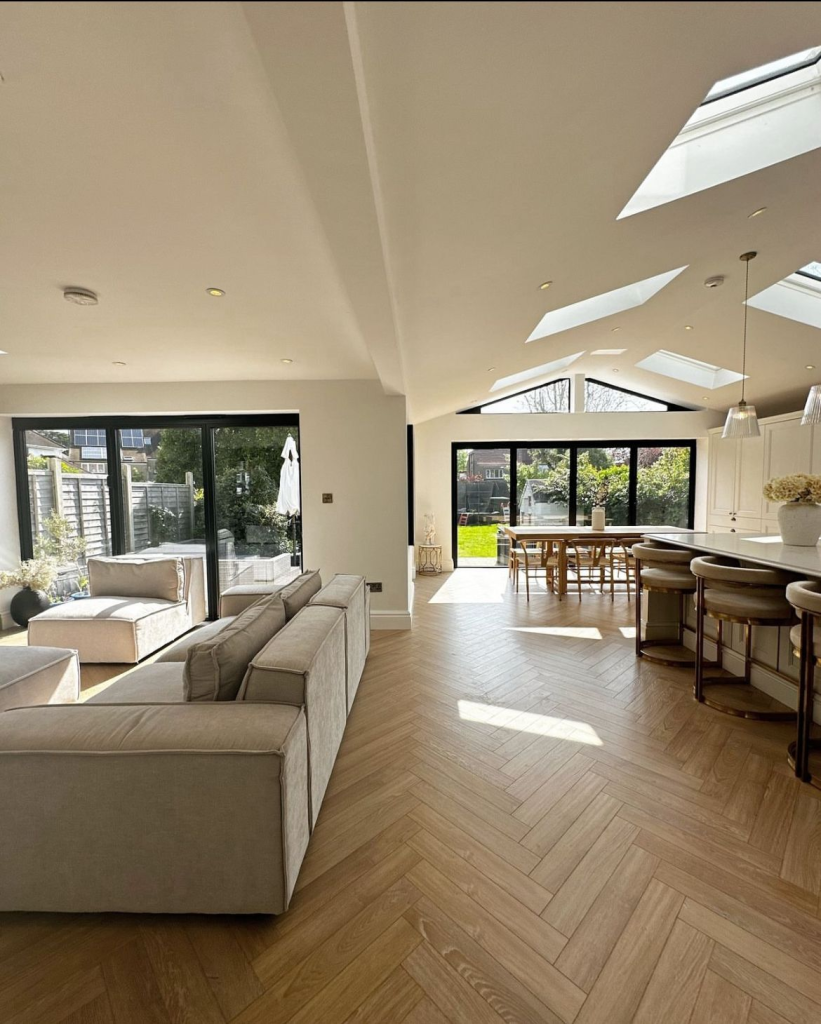
Open or partially open kitchens are some of the most meaningful Home Upgrades for families because they improve sightlines and create a natural gathering space.
When kids are younger, you can cook while supervising. When kids are older, the kitchen becomes the homework hub, the snack headquarters, and the place your teen’s friends inexplicably gather even when you built a whole basement for them.
But an open kitchen only works if it’s properly planned. “Open” without clearances is just chaos.
The NKBA kitchen planning guidelines recommend a work aisle width of at least 42 inches for one cook and at least 48 inches for multiple cooks. Families often have multiple cooks, or at least multiple bodies in the kitchen at once. That’s why these planning recommendations matter for real-world Home Upgrades.
The same NKBA guidance also recommends landing areas next to cooking surfaces (for example, 12 inches on one side and 15 inches on the other) and includes safety-related guidance for island or peninsula cooking surfaces, including countertop extension behind the cooking surface. Those details help prevent spills, reduce crowding, and improve safety in busy family kitchens—exactly what you want from Home Upgrades.
Now let’s talk about a family safety feature that’s becoming more common: induction cooktops.
The U.S. Department of Energy explains that induction cooking uses an electromagnetic field to transfer currents directly to cookware and that the heat is created within the cookware; as soon as you remove the cookware, the heating stops. DOE also notes you can cook without the cooktop getting as hot as it would on a traditional gas or electric cooktop.
ENERGY STAR messaging for electric cooking products similarly notes that induction heats the cookware so the cooktop surface won’t be hot to the touch without a pot or pan in place, and that less heat is released into the kitchen compared to gas or standard electric—helpful when you have kids running around and you don’t want extra ambient heat.
Real talk: induction does not mean “zero heat.” The surface can still be hot from residual heat when the cookware transfers heat back. But for many families, induction is one of those Home Upgrades that can reduce certain hazards and make day-to-day cooking feel more controlled.
If a full open concept isn’t possible, a partial opening still matters. Widening a doorway, opening a pass-through, or reworking a peninsula into a more social island can deliver most of the benefit.
The goal is simple: make the kitchen a space where family life can gather, not a space that isolates whoever is cooking.
Opt For Rounded Edges And Softened Corners
Toddlers fall. A lot. Sometimes they fall even when they’re standing still, which is honestly impressive.
Sharp edges and corners are a common home hazard at exactly the height a toddler’s face and head tend to be. The American Academy of Pediatrics recommends checking for furniture with hard edges and sharp corners that could injure a child (coffee tables are highlighted as a particular hazard) and removing dangerous furniture from traffic areas when possible, especially while children are learning to walk.
You can baby-proof with corner guards, and that helps. But if you want long-term Home Upgrades, treat edge safety as a design decision—so you’re not living with foam bumpers forever.
In kitchens, ask about eased or softened edge profiles for countertops. It’s a small design choice that can reduce injury severity when a child bumps a corner.
In living spaces, choose a round table, or swap a sharp-edged coffee table for a large upholstered ottoman. That gives toddlers a safer surface to pull up on, and it’s still normal-looking when your kids are older. This is the key: Home Upgrades should protect without making your home feel like a daycare.
Also, pay attention to built-ins. Benches, mudroom cabinetry, and entertainment centers can be designed with softened corners. It’s a tiny detail during design and a big relief in real life.
Install Adjustable Closet Systems That Can Keep Up
Closets are the silent battleground of family life. If closets don’t work, mornings get harder. Laundry becomes a bigger problem. Everyone feels behind.
Adjustable closets are one of the more underrated Home Upgrades for families because they let you reconfigure storage as kids grow—without rebuilding.
A closet planning guide from Knape & Vogt makes the point plainly: storage needs change and flexibility is essential in designing a closet. It also offers practical guidance on hanging rod heights: short hanging items may use rods around 30 to 40 inches from the floor; a typical two-rod setup places a top rod around 80 to 82 inches and a bottom rod around 40 inches; and for young children, one rod around 36 to 40 inches off the floor is suggested when there aren’t many hanging items.
That’s exactly why we recommend adjustable systems as Home Upgrades. The height and layout you need for a toddler is not what you need for a teen. But if the system is adjustable, that change is a weekend project—not a renovation.
Two contractor rules make this upgrade work long term.
Build for strength. Closet systems fail when they aren’t anchored properly or when loads aren’t respected. Hardware planning guidance includes notes about spacing and attaching components for safety and stability, which is especially important when kids start pulling, hanging, and climbing.
Plan zones. A kid closet that’s “all hanging” rarely works. A mix of hanging, shelves, and a small drawer section tends to stay functional longer. Even if your child’s clothing changes, storage categories do not: hanging, folded, shoes, accessories, and seasonal overflow.
There’s a deeper benefit too: closets that are reachable help build independence. When a child can reach their own clothes and put things away, you’re building a routine. And routines are one of the most underrated Home Upgrades in a family home because they reduce daily friction.
Upgrade To Solid-Core Doors For Sound And Privacy
Now we’re back to the drum set.
Noise is a “new problem” every few years of parenting. In the baby stage, you’re protecting naps. In the teen stage, you’re trying to coexist with louder hobbies, louder friends, and louder everything.
Upgrading hollow-core interior doors to solid-core doors is a surprisingly powerful set of Home Upgrades for sound control, durability, and privacy.
To understand why, it helps to know what STC is. Sound Transmission Class (STC) is a single-number rating used to describe how well a building partition blocks airborne sound; it’s calculated using standardized methods (ASTM E413 is one such method for calculating single-number acoustical ratings, including STC).
You don’t have to become an acoustics engineer to benefit from this. The core idea is mass and construction. A denser door generally blocks more sound than a lightweight door.
Manufacturers discuss this in practical terms. JELD-WEN, for example, describes solid-core interior doors as engineered to help buffer sound transmission and notes that some products achieve STC ratings into the low 30s or higher depending on the door line and assembly.
This upgrade is especially helpful in:
Nurseries and kids’ bedrooms, for sleep protection.
Teen bedrooms, for privacy and noise control.
Basement hangout rooms, so the rest of the house can still function.
Home offices, if you work from home.
Bathrooms, because privacy matters and hollow-core doors don’t help.
To make these Home Upgrades work even better, don’t forget the gaps. Sound leaks through air paths. Tightening the door stop, improving the seal, and addressing under-door gaps can make a noticeable difference.
Also, if you’re finishing a basement for kids, think about sound early. A solid-core door at the basement stair entry is often one of the best “bang for your buck” Home Upgrades in terms of household peace.
The Bonus Home Upgrades That Make The Biggest Difference Over Time
There’s one upgrade category that families often forget until it’s too late: flexible spaces.
A flexible space is the room that can change identities without becoming awkward.
Playroom becomes study space.
Study space becomes teen hangout.
Teen hangout becomes guest room.
Guest room becomes home gym.
If you design flexibility intentionally, you get decades of use out of the same square footage. Those are Home Upgrades that help a family stay in their home longer because the house stays useful.
This isn’t just a homeowner preference—it shows up in housing trends. NAHB has reported that builders expect to incorporate more transition or flex spaces (including drop zones and multi-purpose rooms), reflecting the real demand households have for spaces that adapt.
How do you design flexibility like a contractor?
Plan power and data. If you want a space to become a study zone or media room, you need outlets and charging in the right places.
Plan lighting in layers. Overhead for general use, plus task lighting for homework or hobbies.
Plan storage that can shift. Built-ins can be designed with adjustable shelving and a mix of open and closed storage so the room can change moods.
Plan sound. If this space might become a media room or teen hangout, the solid-core door recommendation above becomes even more important.
The “bonus” here is that flexible spaces can also protect resale. Buyers consistently value homes that can handle modern life and shifting needs. Even the Cost vs Value conversation around remodeling tends to emphasize that some projects hold value well because they improve daily livability and broad appeal.
How MGS Plans Family-Focused Home Upgrades
Remodeling with kids is not just construction. It’s lifestyle management.
At MGS Contracting Services, our primary goal is to give you the home you’ve always dreamed of in a way that fulfills you rather than puts pressure on you. We start with your vision, then bring it to life as efficiently as possible—whether that’s a kitchen, bathroom, basement, whole-home remodel, or an addition.
We also bring a professional commitment to standards. Our “About” page notes MGS is a member of NAHB and NVBIA and operates with a Class A Virginia contractor license.
Here’s what that means for family Home Upgrades in practical terms.
We plan around real life. That means discussing your daily routines and what’s going to change. It’s easy to design a pretty space. It’s harder—and more valuable—to design a space that supports school mornings, sports seasons, and the fact that kids grow fast.
We aim to reduce redo work. The cheapest remodel is the one you don’t have to do twice. That’s why we push for flexible storage, durable materials, and layouts that can evolve.
We think about safety early. Tip-over risk, sharp corners, scald protection, and sound control aren’t “extras” in a family home. They’re part of responsible Home Upgrades planning.
We communicate. Remodeling anxiety usually comes from uncertainty. When homeowners understand what’s happening next, the project feels manageable even when it’s inconvenient.
This is how we build Home Upgrades that feel good long after the last punch-list item is done.
Planning, Permits, And Building Home Upgrades The Right Way In Loudoun And Fairfax
One more contractor reality check: some of the best family-friendly changes—like opening a kitchen or relocating plumbing—can trigger permitting and code requirements. That’s not a hassle; it’s part of building safely, and it protects your home.
In Virginia, the Virginia Uniform Statewide Building Code (USBC) contains the building regulations that must be complied with not only for new construction but also for additions to existing buildings, and when maintaining, repairing, renovating, or changing the use of buildings.
Virginia’s administrative code also states that a permit must be obtained prior to commencement of certain activities (with limited exceptions and emergency provisions).
Locally, Loudoun County’s Department of Building and Development issues building permits (and provides permitting resources for residents). Fairfax County Land Development Services similarly explains that permits allow construction activities and that the type of permit depends on your scope of work.
Here’s what that means for your Home Upgrades:
If you’re opening a kitchen wall, you may be dealing with structural work. Removing or altering framing requires correct design and inspections.
If you’re reworking a bathroom, plumbing and electrical changes can require trade permits and inspections.
If you’re wiring built-ins for charging drawers, media centers, or added outlets, electrical work needs to be done safely and legally.
If you’re finishing a basement or adding a bedroom, there can be safety requirements tied to things like egress and other life-safety elements.
A professional remodeling process makes permitting and code compliance part of the plan, not a surprise.
You don’t need to renovate your home every time your kids grow into a new stage. You need Home Upgrades that were designed for change from the beginning.
A tub that works for toddlers and adults. Built-ins that shift from toy storage to tech. A mudroom that supports routines. A kitchen that lets you supervise, connect, and gather. Rounded edges that protect without looking childish. Closets that adjust with growth. Doors that reduce sound and increase privacy.
That’s how you future-proof instead of only baby-proofing. That’s how you invest once and live better for years.
And it’s exactly what we aim to build at MGS Contracting Services: Home Upgrades that hold up to real life, from toddler chaos to teenage independence, across Loudoun and Fairfax County.