
You do not need to drive to the park every weekend to give your kids a place to climb, swing, imagine, and burn off energy. That is the dream behind almost every Backyard Playground, and it is a good dream. Outdoor play supports movement, skill-building, confidence, and child development, and it gives families a practical way to turn ordinary time at home into active time together. A well-planned Backyard Playground can become one of the most-used parts of a property because it puts play where real life actually happens: right outside the back door.
But here is the part most homeowners do not see at first: a Backyard Playground sounds like a weekend project until you realize the structure is carrying real loads, kids do not use equipment gently, and the ground underneath your Backyard Playground matters almost as much as the tower above it. Falls remain the leading source of playground injuries, and emergency departments treat more than 200,000 children ages 14 and younger for playground-related injuries each year. That is why the smartest families approach a Backyard Playground as a safety project, a site-planning project, and a construction project all at once.
That mindset fits the way MGS Contracting Services talks about home projects. On MGS’s official about page, Chris Chapman describes building the company after serving in the Marines, with Danielle Chapman focused on customer service and clear expectations for homeowners. MGS also says its goal is to bring visions to life efficiently and with exceptional craftsmanship, while Chris’s longer profile emphasizes functionality, transparency, and long-term value instead of throwaway upgrades. That same mindset is exactly what a Backyard Playground needs if you want years of fun instead of a season of regret.
So this blog is not going to pretend a Backyard Playground is just a cute collection of swings and slides. This is a real guide for real homeowners. We are going to talk about where a Backyard Playground should go, how big it should be, what the structure needs beneath the surface, why swings turn a simple frame into an engineering problem, how surfacing changes the injury equation, where permits and HOA rules sneak up on you, and what separates a Backyard Playground that feels solid for a decade from one that starts wobbling in year one.
If you are the kind of homeowner who loves DIY, good. A Backyard Playground can absolutely be a satisfying project when it is sized appropriately, designed carefully, and built with discipline. If you are the kind of homeowner who is already thinking, “This sounds bigger than I expected,” that is good too, because that little moment of caution is what saves a lot of Backyard Playground projects from becoming expensive repairs later. Let’s walk through it the smart way.
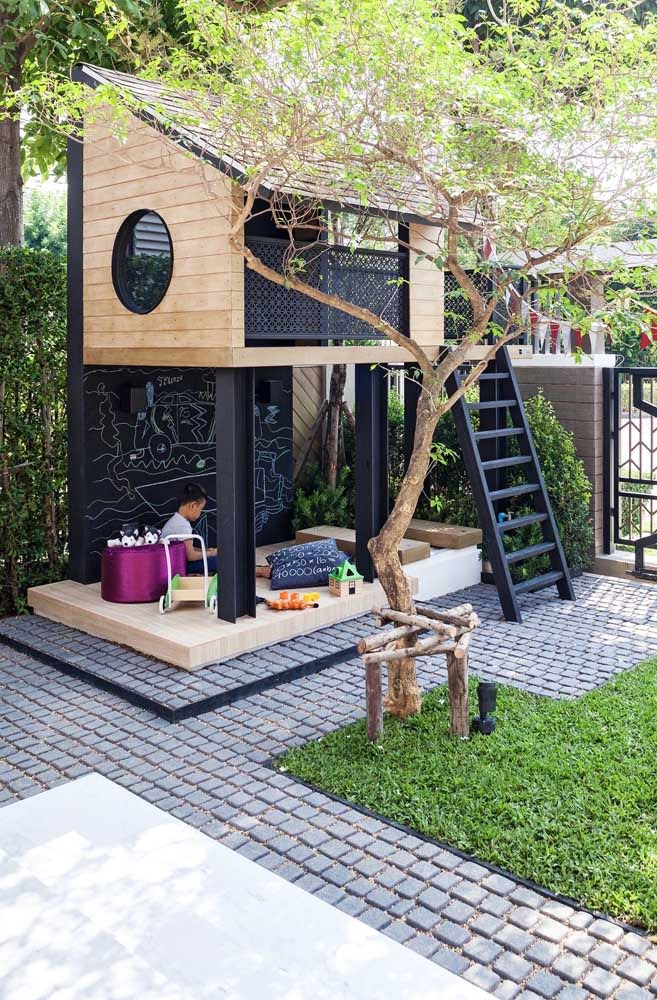
CREDIT: PINTEREST
Plan the Backyard Playground before you buy a single board
The first thing to understand is that the footprint of a Backyard Playground is never just the size of the tower. Homeowners often measure an 8-by-8 platform area and think, “Great, I have room,” but the usable and safe area for a Backyard Playground is much larger because children fall, run, swing forward, swing backward, and move unpredictably between features. CPSC guidance for home play equipment says to provide at least 6 feet of protective surfacing beyond the perimeter of the structure, with even more room in front of and behind swings. That means your Backyard Playground may consume far more yard than the central deck suggests.
Visibility matters more than most people think. CPSC’s home playground guidance recommends locating a Backyard Playground where it is readily visible from inside the house and from patios or porches, and away from roads and driveways. In plain English, that means your Backyard Playground should not disappear behind a detached garage, sit beyond a privacy hedge, or hide around the far corner of the lot just because that corner happens to be empty. If you cannot easily see the Backyard Playground in ordinary family life, supervision gets weaker, response time gets slower, and kids are more likely to use the equipment in ways nobody intended.
Ground conditions are where a lot of Backyard Playground plans begin to win or lose. CPSC advises choosing a level location because it reduces the risk of the set tipping and helps keep loose-fill surfacing from washing away during heavy rain. The same guidance also says some sites may need regrading to improve drainage or reduce slope. In contractor language, that means a Backyard Playground should not be dropped into a low, soggy section of yard just because it is open space. If water sits there after storms, your posts, footings, sandbox area, and protective surface are all going to suffer.
Chris Chapman’s construction philosophy adds a useful lens here. On MGS’s profile, Chris emphasizes functionality and long-term value, and he talks about thinking ahead during design so future uses are accounted for before work begins. That is exactly the right mentality for a Backyard Playground. A Backyard Playground should not be designed only for what your children want this summer. It should be designed around drainage, maintenance, visibility, expansion, and how the space will work when the novelty wears off and ordinary family life takes over.
Sun and shade deserve a bigger conversation than they usually get. A Backyard Playground in full sun is not automatically wrong, but surfaces and equipment can get dangerously hot. The CPSC public handbook warns that bare metal slides, platforms, and steps should be shaded or located out of direct sun, and the home handbook says a north-facing slide receives the least direct sunlight. Research published in Building and Environment found that sun-exposed playground surfaces commonly reached temperatures high enough to burn skin, while shade significantly reduced those temperatures. In other words, the smartest Backyard Playground balances visibility with afternoon comfort and burn prevention.
A good Backyard Playground plan also separates ages and activity types. The CPSC public handbook recommends showing distinct areas for different age groups and separating active uses from quieter uses such as sandboxes, because collisions happen when kids run through mixed activity zones. That means your Backyard Playground should not force a toddler sandbox to sit directly beside a swing arc, and a Backyard Playground with a tower, a slide, and a swing bay should be arranged so children are not crossing through landing zones to get from one feature to the next.
This is where the popular “one rule for every yard” idea breaks down. Some DIY articles talk about a simple buffer zone, but a smarter Backyard Playground uses actual use zones instead of a one-size-fits-all shortcut. Stationary structures need one spacing strategy, swings need another, slide exits need their own clearance, and toddler areas need to be separated from older-kid traffic. If your Backyard Playground has multiple activities, stop thinking in terms of one circle around the whole thing and start thinking in terms of overlapping behavior patterns. That is how adults plan space; that is how a Backyard Playground should be planned too.
Build the Backyard Playground like a real structure
The biggest mental shift in this whole project is realizing that a Backyard Playground is not patio furniture. A Backyard Playground with elevated platforms, rails, ladders, slides, and swings is a small outdoor structure that sees repeated dynamic loading, weather exposure, and hard use. CPSC’s guidance for home playgrounds, public playgrounds, and playground equipment manufacturers all point back to structural integrity, safe materials, proper surfacing, and maintained hardware. If your Backyard Playground is going to live outdoors year after year, nothing about it should be improvised.
Start with lumber selection. CPSC’s home handbook says wood for a Backyard Playground intended for outdoor use should be naturally rot-resistant and insect-resistant, such as cedar or redwood, or treated to prevent deterioration. It also says creosote-treated wood and coatings containing pesticides should not be used. If your Backyard Playground uses pressure-treated wood, the same guidance explains that CCA-treated wood is no longer processed for residential use and that modern treatment chemistries demand compatible hardware because they corrode some metals faster than others. That is not a minor detail. That is the difference between a frame that ages normally and a Backyard Playground that begins rusting at its connections.
Pressure-treated wood categories matter too. The AWPA standard shows that UC4A ground-contact treatment is intended for wood in contact with the ground or used in difficult-to-replace, safety-critical exterior components exposed to weather cycles, and it lists posts, joists, and beams among the typical applications. For a Backyard Playground, that means you should not casually mix low-duty material into safety-critical locations. Posts in or near the ground, lower framing close to splash zones, and members that are hard to replace later need treatment appropriate to the environment your Backyard Playground will actually face, not the environment you hope it faces.
Fasteners deserve the same seriousness. The CPSC public handbook says all fasteners should be corrosion resistant, and it specifically warns that ACQ, CBA, and CA-B treated wood can corrode certain metals faster than others. Simpson Strong-Tie’s corrosion guidance similarly points homeowners and builders toward corrosion-resistant connector families, including hot-dip galvanized and stainless options, for exterior wood construction. A Backyard Playground with the wrong hangers, bolts, screws, or hooks can look complete on day one and still be quietly degrading from the inside. That is why a Backyard Playground should be built with compatible connectors from the start, not patched later when stains and rust appear.
Footings and anchorage are where DIY confidence gets tested. Virginia’s building code guidance says the bottom of footings for structures generally must be below local frost depth, with certain exceptions for some smaller accessory structures, and it stresses that anchoring is of paramount importance regardless of permit exemption. CPSC’s home handbook also says play equipment may need to be anchored to keep it from tipping and that anchors must be buried or covered so they do not create hazards. For a Backyard Playground, that means footing depth, soil bearing, concrete placement, and restraint are not glamorous topics, but they are the backbone of the whole project.
Once your Backyard Playground rises above ground level, fall protection changes. The home handbook says platforms and ramps over 30 inches high should have guardrails or barriers to prevent falls. The public handbook gets even more technical and shows how guardrail and barrier recommendations vary by age and fall height, with stronger enclosure expectations as platforms get higher. So if your Backyard Playground deck is around 5 feet high, do not think of rails as decorative trim. Think of them as a primary safety system, and design openings, heights, and climbability with child behavior in mind.
The central tower in a Backyard Playground should also be laid out to minimize conflicting movements. CPSC says composite structures should be arranged so access components are not located in slide exit zones, and active elements should be dispersed to reduce crowding. That means your Backyard Playground should guide movement intuitively. Kids should know where to climb, where to wait, where to slide, and where to run out without crossing another child’s path. When a Backyard Playground feels chaotic in the plan, it becomes chaotic in use.
Design the play features around real child behavior
Let’s talk about ladders first, because the ladder in a Backyard Playground often gets treated like an afterthought. It should not be. A ladder is the gateway into the structure, and if the ladder is too steep, too narrow, loosely attached, or mismatched to the users’ age, the entire Backyard Playground starts every play session with a weak point. CPSC’s guidance on age groups emphasizes that access methods should be selected based on developmental ability, not just available space, and the home handbook specifically says assembly should follow the manufacturer’s instructions, on level ground, with proper hardware and tightened connections. For a Backyard Playground, that means the ladder must feel intentional, not improvised.
A climbing wall can make a Backyard Playground feel custom, but it also increases the need for good surfacing and smart sight lines. The public handbook distinguishes between age groups, elevated surfaces, and use zones because climbing equipment changes how children fall and how they challenge themselves. The National Program for Playground Safety notes that equipment above 5 feet more than doubles injury probability, which is a useful reminder that every inch of added challenge in a Backyard Playground needs a matching upgrade in landing protection and supervision. A climbing wall is great; a climbing wall without a real fall strategy is not.
The sandbox is one of the smartest features in a Backyard Playground when it is placed well. CPSC recommends separating quiet activities such as sandboxes from active moving equipment like swings, because the problem is not just falls from height but also traffic conflict. In practice, that means the best Backyard Playground does not tuck the sandbox wherever there is leftover room. It gives the sandbox a zone that feels calm, visible, shaded when possible, and outside of every swing path and slide exit pattern. Quiet play works best when the rest of the Backyard Playground is not constantly storming across it.
Now for slides. A slide is often the emotional center of a Backyard Playground because kids notice it first, but slides also have surprisingly technical safety requirements. The CPSC public handbook says the use zone at the end of a stand-alone slide should be at least 6 feet, and that there should be no gaps where the slide chute connects with the platform because clothing or drawstrings can catch there. It also warns against bare metal in direct sun because contact burns can happen fast. So yes, the slide makes a Backyard Playground fun, but only when it lands into open space, meets the deck cleanly, and stays cool enough for real use.
Swings are where many Backyard Playground builds stop being simple carpentry and start becoming structural engineering. The home CPSC handbook says swings should be spaced appropriately, that the front and rear clearance should equal twice the top-bar height, and that lightweight seats are preferred over heavy metal or wood seats to reduce injury if a child is struck. The public handbook adds that the use zone in front of and behind single-axis swings should never overlap another use zone, no more than two swings should hang in each bay, and swings should not be attached to composite structures. That is a huge clue for any Backyard Playground designer: separate swing bays are usually the smarter call.
That last point matters enough to repeat. If your Backyard Playground tower is carrying a deck, a roof, guardrails, a slide opening, and climbing traffic, then asking that same frame to absorb the repeated side loading and motion of swings is exactly where many DIY ideas go sideways. CPSC’s guidance is clear that swings deserve their own use zones and should not be attached to composite structures in public settings, and the home handbook separately recommends disk swings and tire swings in their own bays away from other equipment. The deeper lesson for a Backyard Playground is simple: moving equipment should be treated like a separate system, not a bonus accessory hung wherever a beam looks available.
The “fun extras” in a Backyard Playground are worth doing, but only after the core geometry is right. A steering wheel, telescope, flags, chalk features, or pretend-play accessories can dramatically increase use because they make a Backyard Playground feel like a place, not just an apparatus. Retail listings from Lowe’s and Home Depot show that many popular family playsets combine climbing, slides, trapeze elements, and sandboxes because variety matters to real-world play. Just be careful not to clutter the structure with decorative pieces that create protrusions, snag points, or crowd the circulation pattern. The best Backyard Playground is imaginative without becoming chaotic.
Age matters here too. ASTM’s home playground equipment standard applies to various home equipment types intended for children over 18 months through age 10, which is a useful reminder that many off-the-shelf assumptions are built around younger kids, not roughhousing middle schoolers. If your Backyard Playground is going to see older siblings, neighborhood kids, or multiple users at once, then your thinking about height, loads, supervision, and wear has to become more conservative, not less. A Backyard Playground that “meets the minimum” for smaller children might not remotely match the reality of how your household actually plays.
Budget permits and local rules shape every Backyard Playground
Let’s be honest about money. A Backyard Playground can save you cash compared with a premium prebuilt system, but only if you budget the whole project instead of just the visible lumber. Angi’s current DIY guidance estimates materials for a basic DIY playground at roughly $700 to $1,000, while pre-made playsets can run from around $1,000 to $6,500 or more, with professional installation adding more cost. Retailers such as Lowe’s and Home Depot show the market is broad, with smaller swing-and-slide options in the hundreds and larger wood playsets climbing past $1,000 quickly. In other words, the real budget for a Backyard Playground usually comes down to scope, not just whether you DIY.
Where budgets go sideways is almost always in the same places. A Backyard Playground gets more expensive when the site needs grading, when drainage has to be corrected, when the surfacing has to be contained, when you decide to use premium hardware, when you need a separate swing bay, or when you suddenly realize the “simple” Backyard Playground also needs borders, landscape fabric, geotextile, gravel, delivery, painted or stained finishes, and replacement blades for every saw you own. The structure itself may be the visible cost, but the invisible costs are what determine whether a Backyard Playground feels cheap, sturdy, or frustratingly unfinished.
Surfacing alone can change the math. CPSC’s home handbook says one of the most important ways to reduce the likelihood of serious head injury is to install shock-absorbing protective surfacing under and around play equipment, and it recommends 9 inches of loose-fill materials such as wood mulch, engineered wood fiber, or shredded rubber for equipment up to 8 feet high, while sand and pea gravel at 9 inches suit lower fall heights. The public handbook adds that loose-fill materials compress at least 25 percent over time, so a Backyard Playground using loose fill needs more material initially and ongoing replenishment later. Budgeting a Backyard Playground without budgeting surfacing is not budgeting honestly.
The permit conversation is where homeowners are often either overly afraid or dangerously casual. The Virginia Uniform Statewide Building Code applies to the construction and maintenance of buildings and structures, and enforcement is handled by local building departments. At the same time, CPSC notes there are no specific federal statutory requirements aimed only at outdoor home playground equipment, though CPSC points industry to ASTM F1148 and its home-playground safety guidance. The practical takeaway for a Backyard Playground is this: do not assume “backyard” means “rule-free,” and do not assume national safety guidance answers your local zoning and permit questions automatically.
Loudoun County’s official permitting page says you must obtain permits from the appropriate county agencies before beginning construction and that applicants remain responsible for other necessary approvals, including incorporated towns and HOA or POA requirements. For homeowners in MGS territory, that means a Backyard Playground in Loudoun County may trigger conversations not just with one office but with the county, possibly a town, and your association if you live in a regulated community. A Backyard Playground does not need to be enormous to create a visibility, setback, or aesthetics issue in a managed neighborhood.
Fairfax County provides an especially useful real-world example because its official accessory structure guidance explicitly lists playsets as freestanding accessory structures. On lots of 36,000 square feet or less, these structures generally are not permitted in front yards. The same guidance says playsets or other accessory structures up to 8.5 feet high can be located in side or rear yards, structures between 8.5 and 12 feet high may be as close as 5 feet to side or rear lot lines, and structures exceeding 12 feet trigger larger setback rules. It also states that structures over 256 square feet require a building permit. That is exactly why a Backyard Playground should be checked locally before you build.
And then there are utilities, the part nobody remembers until the shovel hits something expensive. Virginia 811 says homeowners should contact the service three days before any digging project, and that the service is free and provides the approximate location of buried utility lines. Approximate is the key word. A Backyard Playground that involves posts, anchors, drainage trenches, or electrical runs should never skip line locating. In Virginia, this is not a “nice to have.” It is one of the first grown-up steps in a Backyard Playground plan.
Electricity is another line in the sand between “simple playset” and “real project.” Fairfax County’s permit library says a residential electrical permit is required for new residential service and new electrical equipment or fixtures. So if your Backyard Playground is just wood, surfacing, and play elements, your permit path may be one thing. If your Backyard Playground starts sprouting path lights, speakers, fans, outlets, or accessory lighting for evening use, you may be in very different territory. That is one reason disciplined project scoping matters from the beginning.
Build the Backyard Playground in a logical sequence
A successful Backyard Playground gets built in layers, not in a rush. First comes layout, then utilities, then grade, then footings, then posts, then bracing, then the deck, then rails, then accessories, then surfacing. That order sounds obvious, but homeowners sabotage many Backyard Playground builds by buying accessories first and forcing the structure to fit them later. Angi’s build sequence starts with choosing the site, sizing the structure, getting approvals, laying out posts, digging below frost line, and only then moving into framing, decking, and accessories. A Backyard Playground should be assembled the same way any competent structure is assembled: from foundation logic outward.
Site preparation is more than mowing the grass. A Backyard Playground needs a level, stable base area, and if you are using loose-fill surfacing, the perimeter should be able to contain it. CPSC’s public handbook says good drainage is essential because standing water reduces surfacing effectiveness, leads to compaction, and accelerates decomposition. It also recommends containment at the perimeter and impact mats in high-displacement areas such as under swings and at slide exits. So before your Backyard Playground gets any visible fun built into it, the ground should already be speaking the language of drainage, containment, and maintenance.
Post installation is the point where a Backyard Playground either becomes trustworthy or starts storing up problems. Holes should suit the post size, sit in appropriate soil, account for drainage and frost, and hold the posts plumb while concrete cures or anchoring is installed according to the design. Virginia’s code memo notes that footings generally go below local frost depth and that anchoring matters regardless of exemption. A Backyard Playground that leans slightly when you first brace it is not “close enough.” It is a warning. You correct it while the materials are open, not after the deck boards are fastened and the slide is bolted on.
The deck framing stage is where it helps to think like Chris Chapman. MGS describes a process built around design first, continuous feedback, real-time progress updates, and doing the project right before you move on. That same habit makes a Backyard Playground better. When the frame is open, pause. Check the symmetry. Check the swing bay spacing. Check the slide opening. Check the rail locations. Check the sight lines. Check that the Backyard Playground still works for the children you actually have, not the sketch you made three weekends ago. Adjustments made here are cheap. Adjustments made after finish-out are not.
When you add the rails and barriers, build like children will test them, because they will. The public handbook says guardrails and barriers should completely surround elevated platforms except at entry and exit openings, and the home handbook says anything over 30 inches high should have them. For a Backyard Playground, rails should not wiggle, infill should not create obvious climb-through temptations, and edges should not invite splinters, protrusions, or snag hazards. A Backyard Playground does not become safe because a rail exists; it becomes safer because the rail is strong, continuous, and well thought out.
Accessory installation is where restraint matters. Every Backyard Playground can become cooler with one more feature, one more handle, one more rope, one more hanging element. But CPSC’s home handbook specifically warns about entanglement and says children can be seriously hurt or killed by ropes, cords, leashes, drawstrings, or neck items that catch on equipment. The public handbook also warns about open S-hooks, protruding bolts, and inaccessible hardware issues. So when finishing a Backyard Playground, ask not only “Will kids enjoy this?” but also “Can clothing, cords, or fingers get caught here?” That habit separates good DIY from sloppy DIY.
Once the structure is complete, the final step is not a photo. The final step is surfacing, spacing verification, and a walk-through checklist. CPSC says the protective surface should extend at least 6 feet beyond the play structure perimeter, swing and slide zones need special attention, and loose-fill materials must be maintained to minimum depths. The National Program for Playground Safety adds that loose-fill materials age, erode, and displace, especially in high-traffic areas. So before you ever call your Backyard Playground finished, walk every path a child will run, stand where the slide exits, stand where the swing travels, and rake or refill where the landing zones already look thin.
The smart version of a Backyard Playground build does not end at installation either. The CPSC home handbook recommends checking nuts and bolts twice a month, checking protective caps and plugs twice a month, checking swing seats, ropes, chains, and cables monthly, repairing wear promptly, and raking surfacing periodically to maintain depth. That is not overkill. That is ownership. A Backyard Playground is not a set-it-and-forget-it object. It is a piece of active equipment, and a Backyard Playground stays safe longest when maintenance becomes routine instead of reactive.
The DIY mistakes that make a Backyard Playground fail early
The first big mistake is underestimating motion. A Backyard Playground can feel solid when nobody is on it and still be underbuilt once children start using it aggressively. Swings are the clearest example, but even a Backyard Playground with only climbing and sliding features sees repetitive movement, impact, and torsion. CPSC’s home and public guidance both devote serious attention to anchoring, use zones, seat selection, and swing spacing because moving equipment changes the loads dramatically. If your Backyard Playground plan treats a swing as just another accessory to bolt on late, the plan is already off course.
The second mistake is trusting grass as your whole fall strategy. CPSC’s public handbook says grass and dirt are not considered protective surfacing because wear and environmental conditions reduce their shock-absorbing effectiveness. The home handbook says shock-absorbing surfacing is one of the most important ways to reduce serious head injury likelihood. That means a Backyard Playground placed directly on “soft grass” may still become a hard-packed landing zone surprisingly quickly. A Backyard Playground that looks safe from the kitchen window can be much less forgiving at ground level once the traffic paths wear in.
The third mistake is failing to account for surfacing compression and displacement. The public handbook says loose-fill materials compress at least 25 percent over time, and that areas under swings and at slide exits need extra attention because the material moves there fastest. The National Program for Playground Safety reaches the same conclusion, noting that loose-fill protection degrades with age, weather, usage, and erosion. So if a Backyard Playground starts with exactly the minimum visible depth, it will not stay there. A Backyard Playground built on slim surfacing margins is basically planning for maintenance failure from day one.
The fourth mistake is ignoring corrosion until rust is visible. CPSC warns that modern pressure-treated wood chemistries can corrode certain hardware faster, and both CPSC and Simpson point toward corrosion-resistant hardware and compatible connectors. A Backyard Playground does not have to be coastal to suffer hardware problems. Moisture, irrigation overspray, trapped debris, and daily weather cycles are enough. If your Backyard Playground uses bargain hardware not rated for treated wood and exterior use, the savings are likely to disappear the first time you start replacing hangers, hooks, washers, and stained fasteners.
The fifth mistake is building for the picture instead of the child. Homeowners love the idea of a dramatic Backyard Playground with a tall tower, a steep slide, a big swing bay, and a rock wall because it looks impressive. But CPSC separates recommendations by age and the NPPS notes that injury probability rises with greater equipment height. If your Backyard Playground is mainly for toddlers and preschoolers, the “more extreme” version can actually be the worse version. A Backyard Playground should challenge children just enough to keep them engaged without pushing them into equipment that overwhelms their size, reach, coordination, or judgment.
The sixth mistake is clutter. A Backyard Playground becomes less safe when every side gets a feature. CPSC says active and passive play should be separated, slide exits should land in uncongested areas, and composite structures should avoid conflicts between access points and landing zones. So if your Backyard Playground has a ladder here, a climbing wall there, a slide landing in front, and a swing path cutting across the side, you do not have variety. You have conflict. The best Backyard Playground usually has fewer features than a catalog fantasy and better spacing than most Pinterest boards.
The seventh mistake is forgetting that maintenance is part of the design. A Backyard Playground with complicated corners that trap mulch, hidden bolts that never get checked, or surfacing that escapes into the lawn every storm is a Backyard Playground that will become lower-maintenance in theory and higher-risk in reality. CPSC recommends maintenance records, routine inspections, and prompt repairs because fields of use reveal problems over time. If your Backyard Playground design makes it annoying to inspect the hardware or refill the landing zones, the design itself is working against safe ownership.
When to DIY and when to call MGS Contracting Services
A DIY Backyard Playground makes sense when the project is modest, the site is level, the users are young, the structure is low to moderate in height, and you have real confidence with layout, framing, treated lumber, exterior hardware, and anchoring. A DIY Backyard Playground also makes more sense when you are willing to maintain it. CPSC’s own home guidance assumes ongoing inspection and upkeep, not one-time assembly. So if you enjoy measured work, methodical checks, and the idea of owning the maintenance calendar for your Backyard Playground, DIY can be rewarding.
A contractor becomes the smarter move when your Backyard Playground has slope issues, drainage issues, added electrical, large spans, a separate swing structure, tricky setbacks, HOA visibility concerns, or an overall footprint that starts interacting with decks, patios, fences, retaining walls, or outdoor living spaces. The moment your Backyard Playground begins to behave like part of a larger property improvement instead of a standalone kit, the value of professional planning rises fast. In Virginia, that is especially true once permits, trade work, or local zoning questions enter the picture.
This is where Chris Chapman’s approach becomes relevant even if your project is still partly DIY. MGS’s materials describe a collaborative design-build process, continuous homeowner feedback, real-time updates during work, and a strong emphasis on function, transparency, and long-term value. Chris’s profile also says he prefers to think ahead and solve for how families really live. That is exactly the perspective a Backyard Playground deserves. Even if you are not hiring out the entire Backyard Playground, using a contractor’s planning discipline can keep you from making the most expensive mistakes first.
It is also worth remembering what MGS actually represents as a brand. MGS says it serves homeowners across Leesburg, Ashburn, Sterling, Herndon, Reston, Vienna, Great Falls, and more of Loudoun County and Fairfax County. The company also identifies itself as a licensed Class A Virginia contractor and a member of associations including NAHB, HBAV, and NVBIA. That matters because a Backyard Playground is not just a kids’ project; it is a home-improvement decision taking place on a real site, under real local rules, with real construction consequences.
So here is the honest ending. A Backyard Playground can be one of the best family projects you ever build. A Backyard Playground can also become a frustrating mess if you rush the site, cheap out on surfacing, guess wrong on hardware, or hang moving equipment from a structure that was never meant to take that load. The difference usually is not enthusiasm. The difference is discipline. A Backyard Playground that is planned like a real structure, built like a real structure, and maintained like a real structure will give you what you wanted from the beginning: years of play, less worry, and a home that works harder for your family.
And that is the most important takeaway for any homeowner reading this through the lens of MGS Contracting Services. Chris Chapman built MGS around craftsmanship, customer care, and doing the job right, and that same standard is the right standard for a Backyard Playground. If your Backyard Playground stays DIY, use that standard. If your Backyard Playground starts growing into a more complex site-and-structure project, bring that standard with you when you decide who should help. Either way, the goal is the same: build more than a playset. Build a Backyard Playground your family will trust, use, and remember.